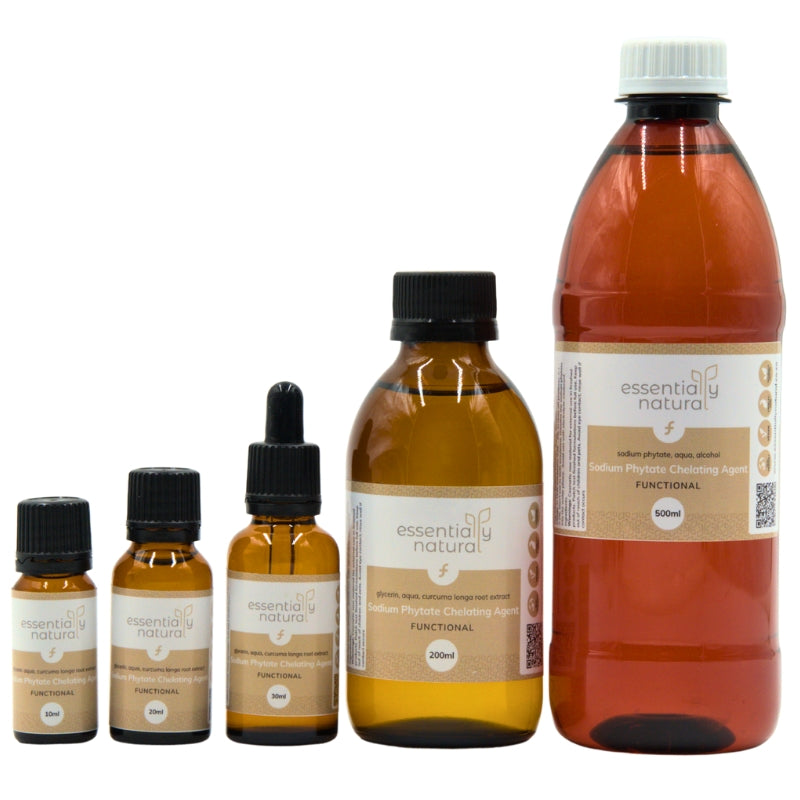
Sodium Phytate (Chelating Agent) - Essentially Natural
Sodium Phytate (Chelating Agent) - Essentially Natural
Couldn't load pickup availability
Sodium Phytate is a natural chelating agent used in water-based formulations to bind trace metal ions. By tying up metals that can speed up oxidation, it helps protect colour, scent, and oxidation-sensitive ingredients in finished products. It is a readily biodegradable alternative to EDTA and is widely used in serums, toners, gels, shampoos, body washes, and O/W emulsions.
Key properties
- Function: Chelating agent for water-based formulations
- Benefits In Formulas: Helps reduce oxidation-related discolouration, supports preservative performance, and can improve foam quality in hard water
- Format: Liquid chelator (water phase compatible)
- Usage Rate: 0.05% to 2% (O/W emulsions), 0.1% to 0.2% (rinse-off)
- Not Suitable For: W/O emulsions
- Ingredients: Sodium Phytate, Aqua, Alcohol
- Trade Name: Dermofeel PA-3
- Country Of Origin: Varies by batch
What it’s used for
- Chelating metal ions in water-based products
- Helping reduce oxidation and discolouration in emulsions and surfactant systems
- Supporting preservative performance in challenging formulas
- Helping maintain foam performance in hard water
- Serums, toners, gels, shampoos, body washes, lotions and creams
Who it’s for
- DIY formulators wanting an EDTA alternative for “cleaner label” projects
- Water-based formulas that discolor or develop off-notes over time
- Rinse-off products used in hard-water environments
- Formulas that include oxidation-sensitive ingredients
- A preservative
- A finished product intended for direct application to skin
This product is suitable for:
This product is not:
How to use
- As A Water-Phase Add-In: Dissolve into the water phase and mix until uniform.
- Typical Use Level In O/W Emulsions: 0.05% to 2%.
- Typical Use Level In Rinse-Off Products: 0.1% to 0.2%.
- Formulation Note: Do not use in W/O emulsions.
- Processing Tip: Sodium phytate is an electrolyte, so avoid pairing with electrolyte-intolerant ingredients.
- Processing Tip: It pairs well with antioxidants such as Vitamin E and ascorbyl palmitate.
- Processing Tip: Check and adjust final pH as needed after adding to your formula.
Safety instructions
- Cosmetic raw material for external use in finished products
- Patch test finished formulations before full use
- Avoid eye contact and rinse well if contact occurs
- Keep out of reach of children and pets
- Store tightly closed in a cool, dry place away from heat and direct sunlight
- Use clean utensils to avoid contamination
Faqs
Q: Does sodium phytate replace a preservative?
A: No. It can support preservative performance, but you still need an appropriate preservative system for water-containing products.
Q: Why use a chelating agent if I already use antioxidants?
A: Chelators address metal-triggered oxidation pathways, while antioxidants help slow oxidation in other ways, so they are often used together.
Q: Can I use it in any emulsion type?
A: It is suited to water-based systems and O/W emulsions, but it is not recommended for W/O emulsions.