Formulating With Glycolic Acid
Juliette van der MeerIn this guide, you’ll learn:
- what glycolic acid is and how it works in formulations
- safe pH ranges and usage levels for home formulation
- how to dilute concentrated glycolic acid correctly
- which ingredients pair well with glycolic acid (and which don’t)
- how to formulate a simple glycolic acid toner
Glycolic acid is an alpha hydroxy acid and chemical exfoliant. It helps slough away dead skin cells, leaving the skin smoother, evening tone and texture, helping with pigmentation and acne, and even providing some antiaging benefits.
Glycolic acid has a small molecular structure, allowing it to penetrate the skin. It can stimulate collagen production in the skin and enhance penetration of other actives, as it removes buildup and dead cells on the skin's surface and in pores.
Glycolic acid is commonly found in toners, serums and peels, and is a favourite ingredient in anti-pigmentation products.
Let's learn how to work with it:
What is the solubility of Glycolic Acid?
Glycolic acid is soluble in water and water-based substances.
If you want to combine it with oils, you will require an emulsifier. More on this further on.
What is the pH of Glycolic Acid?
Glycolic acid prefers to be in its natural very acidic state of around 1.7.
However, you will need to adjust the pH up for the skin and product/ingredient requirements and it will remain effective. We recommend a pH of around 3.5 - 4 for most products.
What is the recommended usage or concentration for Glycolic Acid?
Do not apply undiluted glycolic acid directly to the skin! It is strong and needs to be diluted.
Recommended usage rate for glycolic acid (home environment): 0-20% depending on the product.
Professional usage rates do go higher but we do not recommend you try these at home, or without professional supervision.
Recommended amounts of glycolic acid in specific products:
- Cleanser (rinse off product): 5-10% glycolic acid
- Toner: 1 - 2.5% glycolic acid
- Serum: I've seen up to 10% but do be careful of sensitivity. I recommend going lower.
- Moisturiser: typically, around 1-5%
We will discuss more on concentrations and diluting later on in this article.
When Glycolic Acid Is A Good Choice
- Uneven texture or tone
- Congestion and surface dullness
- Rinse-off or short contact products
When Glycolic Acid May Not Be Appropriate
- Very sensitive or compromised skin
- Daily use at moderate to high concentrations
- Formulations containing protein-based ingredients
Is Glycolic Acid Safe To Formulate With At Home?
Glycolic acid can be safely used in home formulations when diluted correctly, used at appropriate concentrations, and adjusted to a skin-friendly pH. High-strength peels and professional-level concentrations should not be attempted without training or supervision.
How Does Glycolic Acid Affect Skin Sensitivity?
Like any acid, glycolic acid can make the skin sensitive. You may experience a little redness or stinging if you are using it in amounts higher than 5% - this is normal. However, if you experience discomfort, pain or irritation, please rinse it off with water, apply something soothing to the area and discontinue use.
Please wear SPF during the day and avoid direct sunlight after use.
We recommend using glycolic acid one to three times per week. It is not necessary to use it every day as it can weaken the skin's barrier (despite all its benefits, it is still a relatively strong acid).
If you want to use glycolic acid as a skin peel, please read here: At Home Facial Peels.
Which Are the Best Pairings for Glycolic Acid?
Glycolic acid works well with most other water-based substances: water, hydrosols, infusions etc. It will easily dissolve into these solvents.
It can work well with hyaluronic acid.
Salicylic acid, a BHA, can be used with glycolic acid, but in very small amounts or it may cause irritation.
Combining with other acids: glycolic acid can be combined with other acids but be careful of their strengths (think of individual acid strengths and their combined strength) or they may cause irritation.
Could you combine glycolic acid with protein-based ingredients? Like any medium to strong acid, glycolic acid will denature proteins and protein-based substances. You know how adding lemon juice or vinegar to milk will make it curdle? Well, same thing goes for glycolic (and lactic) acid and other protein-based ingredients. So don't combine glycolic acid with hydrolyzed proteins, collagen, keratin, buttermilk powder, other dairy-based ingredients, or amino acid-based surfactants such as sodium lauroyl sarcosinate.
You can use glycolic acid in emulsions but you will need to watch the pH. Glycolic acid can quickly drop the pH very low, and most emulsifiers can't handle a pH below 3.5 - 4. So, you may need to adjust the pH up a little, or the emulsion will break.
What Types Of Products Contain Glycolic Acid?
Glycolic acid is found in cleansers, toners, serums, moisturisers and peels.
It will have maximum benefit when it is allowed to sit on the skin a little, eg in a serum, toner or peel. But we also recommend a glycolic/lactic acid body wash for some gentle chemical exfoliation.
How Do I Dilute Glycolic Acid?
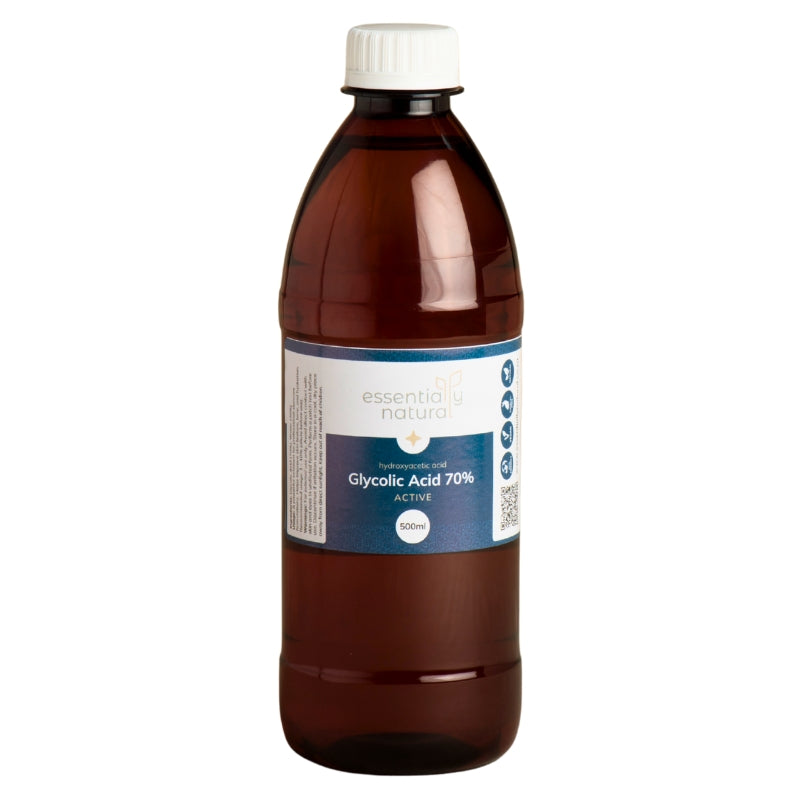
Certain ingredients like acids come in standard concentrations, such as 70% glycolic acid, 80% lactic acid, and 1% hyaluronic acid. But you may want to have a different concentration in your product. For example, you may want to have a total of 10% AHAs in your peel. So how on earth do you go from a 70% concentration of glycolic acid down to 10%?!
This is where dilutions come in.
Understanding Concentration And Dilution (C1V1 = C2V2)
This equation is a standard formulation tool used to calculate how much of a concentrated ingredient is needed to achieve a desired final strength.
Dilutions, concentrations and percentages are commonly found in chemistry, but fortunately, you don't need to be a chemist to work with them. There is a simple equation that makes use of grade school math and a calculator that you can use to find out the dilutions required in order to achieve specific concentrations of actives in your products.
The equation is C1V1 = C2V2, where C is the concentration (%) and V is the volume (mils, or in our case we measure by weight not volume so it will be grams).
If you know any three of the values, you can solve for the fourth!
Let's do an example.
Say we have some glycolic acid 70%, but we want to make a peel that contains a final concentration of 10% glycolic acid. How much glycolic acid do we need to use, and how much do we need to dilute it by?
We know C1, the starting concentration: glycolic acid is 70%. We also know C2, our end concentration, because we have decided we want it to be 10%.
We like working in amounts of 100g (or 100ml), because 100 is a nice round number to play with, and it is a 1:1 conversion from percentages. So here, 100g will be our V2. If you want a different amount you can simply change it to whatever you want.
So, we will be solving for V1. Rearrange the equation to look like this:
V1 = C2V2/C1
Put your % amounts into decimal form for ease of calculation, eg. 10% = 0.1
V1 = (0.1 x 100)/0.7
V1 = 14.29g
So, you will dilute 14.29g of glycolic acid 70% with 85.71g (100g - 14.29g) of water or other ingredients to end up with a 100g solution of 10% glycolic acid.
The C1V1 = C2V2 equation can be used for any concentration that you want to convert into a different concentration.
Amounts of glycolic acid needed for specific concentrations in formulas:
5% GA concentration: 7.14g/ml to 85.71g/ml water
10% GA concentration: 14.29g/ml to 85.71g/ml water
15% GA concentration: 21.43g/ml to 78.57g/ml water
20% GA concentration: 28.57g/ml to 71.43g/ml water
You shouldn't be going higher than this without professional supervision.